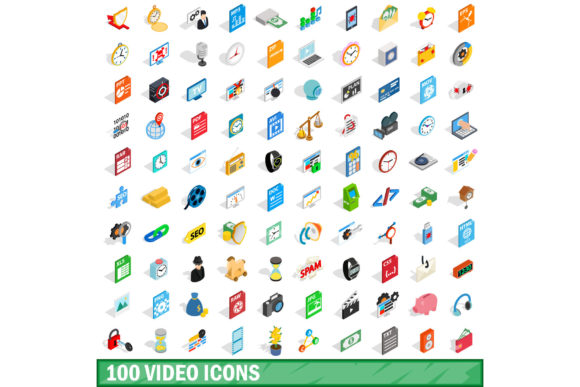
100 Video Icons Set, Isometric 3d Style: A Practical Guide for Designers
In the landscape of digital design, visual consistency is often the difference between a polished professional product and an amateurish presentation. When working on video content platforms, streaming interfaces, or multimedia tutorials, finding a cohesive set of symbols that bridges the gap between flat simplicity and three-dimensional depth can be challenging. This is where the 100 Video Icons Set, Isometric 3D Style becomes a critical resource. Unlike standard two-dimensional clip art, this collection offers a specific aesthetic that adds dimensionality to user interfaces without overwhelming the viewer with heavy graphical loads.
The core appeal of this icon set lies in its unique blend of technical precision and artistic flair. Isometric projection creates a pseudo-3D effect that provides depth while maintaining geometric accuracy. For designers who need to illustrate concepts like "recording," "streaming," "editing," or "media library," these icons offer a modern, tech-forward look that resonates well with contemporary audiences. The inclusion of multiple file formats—including JPG, EPS, AI, PSD, and PNG—ensures that whether you are building a vector-based web app or preparing high-resolution print materials, the assets remain versatile and scalable.
Distinguishing Features of the Isometric 3D Approach
To understand why a designer might choose the 100 Video Icons Set, Isometric 3D Style over other options, it is essential to examine what distinguishes isometric design from standard 3D rendering or flat iconography. Traditional 3D models often require complex lighting calculations, shadows, and textures that can slow down web performance or complicate mobile responsiveness. In contrast, isometric illustrations rely on a fixed angle (typically 30 degrees) and parallel lines, creating a clean, structured appearance that feels dimensional but remains lightweight.
This specific set leverages that principle to create a unified visual language. Each icon within the collection shares the same perspective, scale, and shading logic. When placed together in a dashboard or a navigation bar, they do not clash; instead, they reinforce a sense of order and professionalism. The isometric style is particularly effective for video-related themes because it allows for the depiction of equipment—such as cameras, microphones, and monitors—in a way that feels tangible and interactive without requiring the user to navigate a full 3D environment.
Comparing Formats: Vector vs. Raster Options
A significant advantage of this resource is the diversity of available formats. The availability of both vector files (EPS, AI) and raster images (JPG, PNG, PSD) addresses different stages of the design workflow. Vector formats are indispensable when scaling graphics for various screen resolutions, ensuring that the 100 Video Icons Set, Isometric 3D Style remains crisp on everything from a smartwatch display to a large format billboard. These files preserve mathematical paths, allowing for infinite resizing without loss of quality.
Conversely, the inclusion of PSD and JPG files caters to workflows that prioritize speed or specific layering techniques. Photoshop documents (PSD) allow designers to manipulate individual layers, adjust colors, or apply filters directly to the isometric elements before finalizing them. This flexibility is crucial when integrating the icons into complex compositions where the original vector data might be too rigid to modify quickly. However, users must weigh the tradeoff: while raster formats offer immediate visual adjustments, they lack the infinite scalability of their vector counterparts. If your project involves responsive web design, relying solely on JPG or PNG versions could lead to pixelation issues on high-DPI screens.
Evaluating Use Cases and Strategic Fit
Selecting the right icon set requires aligning the visual style with the intended platform and audience. The 100 Video Icons Set, Isometric 3D Style excels in environments where engagement and clarity are paramount. It is particularly well-suited for:
- Video Streaming Platforms: The depth provided by the isometric style helps differentiate active buttons from inactive ones, guiding user attention effectively.
- Tutorial and Educational Interfaces: When explaining complex video editing processes, 3D-style icons can visually represent tools and steps more intuitively than abstract flat symbols.
- Corporate Presentations: The professional, polished look of these icons elevates the perceived value of slide decks and infographics related to media production.
- Mobile Applications: For apps focused on content creation, the tactile feel of isometric icons can make the interface appear more inviting and interactive.
However, this style is not universally applicable. There are scenarios where a flat, minimalist approach might be superior. For instance, if a website prioritizes extreme minimalism or adheres to strict accessibility guidelines that favor high-contrast, simple shapes, the added detail of an isometric 3D style could introduce visual noise. Similarly, in contexts where loading speed is the absolute priority, such as low-bandwidth environments, the complexity of 3D-style icons might require more optimization than simple line icons.
Tradeoffs and Limitations to Consider
While the 100 Video Icons Set, Isometric 3D Style offers a robust toolkit, designers must be aware of potential limitations. One primary consideration is color consistency. Because isometric icons rely on shading to create depth, changing the base color can sometimes result in unintended highlights or shadows that break the visual harmony. When adapting these icons for different brand identities, it is often necessary to re-render the assets rather than simply applying a filter, which can be time-consuming if the source files are not organized correctly.
Another factor is the level of detail. With 100 distinct icons covering a wide range of video-related functions, some entries may lean towards detailed realism, while others might be more stylized. While the set aims for uniformity, slight variations in complexity can occur. In a highly curated design system, even minor inconsistencies in line weight or shadow intensity can disrupt the flow. Therefore, thorough inspection of the entire set before integration is recommended to ensure every icon meets the specific standards of your project.
Navigating Alternatives and Complementary Tools
When evaluating resources, it is natural to consider alternatives. Some designers might opt for fully rendered 3D models created in software like Blender or Cinema 4D. While these offer photorealistic results, they come with a steep learning curve and significantly higher file sizes. They are generally overkill for UI elements where the goal is quick recognition rather than simulation. On the other end of the spectrum, flat icon sets are lighter and easier to customize but may lack the engaging "pop" that isometric designs provide.
The 100 Video Icons Set, Isometric 3D Style occupies a middle ground that balances aesthetic appeal with technical efficiency. It is more accessible than full 3D modeling but more dynamic than flat graphics. For teams looking to integrate video functionality into existing designs without a complete overhaul, this set serves as a powerful bridge. It allows for the introduction of a new visual hierarchy without abandoning established design patterns entirely.
Furthermore, the variety of formats supports a collaborative workflow. A graphic designer might work with the AI or EPS files to refine the geometry, while a web developer might utilize the optimized PNGs for implementation. This cross-format compatibility reduces friction between departments and ensures that the vision for the project remains consistent from concept to deployment.
Making the Final Decision
Ultimately, the choice to adopt the 100 Video Icons Set, Isometric 3D Style depends on the specific needs of your project. If your goal is to create a modern, engaging interface that communicates the richness of video content, this set offers a compelling solution. Its ability to provide depth without sacrificing clarity makes it a strong candidate for a wide array of applications, from mobile apps to web dashboards.
Before committing, however, it is wise to prototype the icons within your actual design context. Test how they interact with your typography, background colors, and overall layout. Pay attention to how the isometric perspective behaves at different sizes and whether the shading holds up under various lighting conditions in your mockups. By approaching the selection process with a critical eye and understanding the strengths and limitations of each format, you can determine if this resource is the right fit for your creative vision.
In a market saturated with generic assets, finding a specialized set that combines technical versatility with artistic coherence is invaluable. Whether you are building a new video platform or refreshing an existing one, the 100 Video Icons Set, Isometric 3D Style provides the foundational elements needed to elevate your design strategy. It represents a thoughtful investment in visual communication, offering the flexibility required for diverse projects while maintaining the high standards expected by today's discerning users.