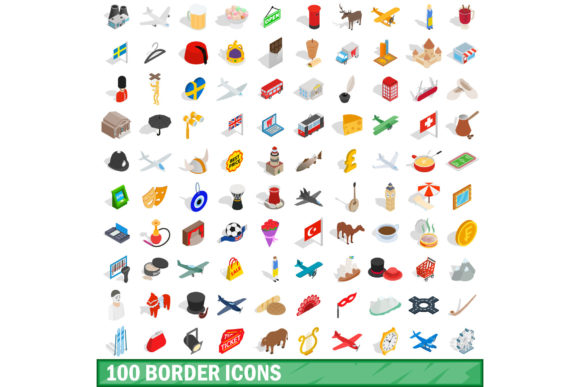
Elevate Your Visuals with the Ultimate 100 Border Icons Set in Isometric 3D Style
In the rapidly evolving landscape of digital design, visual hierarchy and depth are no longer just aesthetic choices; they are essential communication tools. Whether you are crafting a user interface for a mobile application, designing a landing page for a startup, or creating educational materials for an online course, the ability to guide a user's eye is paramount. This is where the 100 Border Icons Set in Isometric 3D Style becomes an indispensable asset. These vector illustrations offer a unique blend of structure and dimensionality that flat design often struggles to achieve.
But what exactly makes this specific collection so valuable? Why should designers invest time in understanding and utilizing isometric borders? In this comprehensive guide, we will explore the significance of these icons, their practical applications across various industries, and how mastering this style can transform your creative workflow from the ground up.
Understanding the Isometric 3D Aesthetic
To fully appreciate the utility of this icon set, one must first understand the underlying concept of isometric projection. Unlike traditional perspective drawing, which uses vanishing points to create depth (making distant objects appear smaller), isometric drawing maintains parallel lines. This creates a consistent scale throughout the image, giving it a technical yet playful appearance.
When applied to border icons, this style adds a layer of sophistication. Instead of a simple two-dimensional line framing your content, an isometric border suggests a physical frame, a window, or a stage. It invites the viewer to look "into" the content rather than just at it. This subtle shift in perception can significantly increase user engagement by making digital interfaces feel more tactile and immersive.
Why Choose Isometric Over Flat Design?
For years, flat design dominated the web, praised for its cleanliness and speed. However, as screens become higher resolution and users demand richer experiences, the limitations of purely flat aesthetics have become apparent. Isometric 3D styles bridge the gap between the clarity of flat design and the realism of 3D rendering.
- Depth without Distraction: Isometric icons provide depth cues that help users understand spatial relationships without overwhelming them with complex shadows or hyper-realism.
- Scalability: As vector illustrations, these borders maintain perfect crispness at any size, from a tiny favicon to a massive billboard.
- Modernity: They signal that a brand is forward-thinking and tech-savvy, aligning perfectly with modern business trends.
It is a common misconception that 3D styles are too heavy or slow for web use. While true for high-poly models, isometric vector art is incredibly lightweight. The 100 Border Icons Set leverages this efficiency, ensuring that your projects remain fast-loading while looking premium.
The Versatility of the 100 Icon Collection
The sheer volume of options within this set—100 distinct variations—ensures that you will never run out of ideas. Each icon is designed to serve as a functional border, meaning they are not just decorative elements but structural components of your layout. Whether you need a rounded corner accent, a full-page frame, or a segmented divider, this collection covers the spectrum.
Imagine you are designing a dashboard for a fintech company. You need to separate transaction history from current balances. A standard horizontal line might work, but an isometric border icon that looks like a sleek, futuristic panel divider could elevate the entire interface, suggesting security and precision. Or consider an e-commerce site selling handmade crafts. An isometric border with organic, slightly softer curves can evoke a sense of warmth and craftsmanship, enhancing the perceived value of the products.
Practical Applications Across Industries
The relevance of these icons extends far beyond simple decoration. Here is how different sectors are leveraging isometric 3D borders in their daily operations:
- Web and App Development: UI/UX designers use these borders to create card layouts, modal windows, and navigation containers. They help define clickable areas and organize information logically.
- Marketing and Advertising: In social media campaigns, bold isometric frames draw immediate attention. They are perfect for highlighting special offers, new product launches, or testimonials.
- Education and E-Learning: Teachers and instructional designers use these graphics to frame quiz questions, module headers, or key takeaways, making learning materials more engaging for students.
- Corporate Presentations: PowerPoint slides often suffer from being text-heavy. Inserting an isometric border around a chart or graph instantly transforms a boring slide into a professional, visually appealing presentation.
Technical Excellence: Formats That Fit Your Workflow
One of the primary reasons this collection stands out is its commitment to compatibility. Designers rarely work in isolation; they often collaborate with developers, copywriters, and project managers who may require files in specific formats. The 100 Border Icons Set addresses this need by providing a comprehensive range of file types: JPG, EPS, AI, PSD, and PNG.
Breaking Down the File Formats
Understanding which format to use when is crucial for maintaining quality and efficiency. Let's clarify the role of each file type included in this set:
- AI and EPS (Vector): These are the gold standards for scalability. If you need to resize a border to fit a large banner or print on a brochure, the vector files ensure the edges remain sharp. They also allow you to edit colors and shapes directly using Adobe Illustrator.
- PSD (Photoshop): For designers who rely on raster editing, layering, and advanced compositing effects, the PSD files are invaluable. They come with editable layers, allowing for quick customization of lighting and texture.
- PNG (Raster): Perfect for web usage where transparency is required. PNG files preserve the alpha channel, ensuring your isometric borders blend seamlessly over any background color or image.
- JPG (Raster): Ideal for quick previews or situations where file size needs to be minimized, though they do not support transparency.
This multi-format approach ensures that whether you are a seasoned graphic artist or a beginner using Canva, you have the right tool for the job. It eliminates the friction of converting files and losing quality in the process.
Maximizing Creativity with Strategic Usage
Having the assets is only half the battle; knowing how to use them effectively is the key to success. To get the most out of the 100 Border Icons Set, consider the principle of context. A border should never overpower the content it frames; rather, it should enhance it.
Start by identifying the mood of your project. Is it serious and corporate? Choose borders with clean lines and muted colors. Is it fun and energetic? Opt for brighter hues and more dynamic angles. Because these are vector illustrations, you have the freedom to recolor them to match your brand guidelines perfectly. Don't be afraid to experiment with gradients or overlaying multiple border icons to create custom patterns.
Furthermore, consider the psychological impact of the "frame." In psychology, framing affects how people interpret information. A border can act as a container for safety and focus. When used correctly, it tells the user, "This information is important; pay attention here." This is particularly useful in call-to-action (CTA) buttons or highlighted features on a website.
Addressing Common Misconceptions
There is often confusion regarding the complexity of working with 3D styles. Many beginners assume that creating isometric designs requires advanced modeling skills in software like Blender or Cinema 4D. While those tools are powerful, they are not necessary for this task. The 100 Border Icons Set provides pre-made isometric solutions that are ready to drop into your design immediately.
Another misconception is that 3D styles are a fleeting trend that will soon pass. History has shown that isometric design has remained relevant for decades because of its unique ability to simplify complex data. It is a timeless style that adapts well to changing trends. By integrating these icons now, you are future-proofing your designs against the inevitable return of depth and dimension in digital interfaces.
Conclusion: Transform Your Design Language
In conclusion, the 100 Border Icons Set in Isometric 3D Style represents more than just a collection of images; it is a toolkit for elevating your visual storytelling. By offering a perfect balance of depth, clarity, and versatility, these icons empower designers to create interfaces that are both beautiful and functional.
Whether you are working on a high-stakes business proposal, a vibrant mobile app, or an educational platform, the right border can make all the difference. With support for JPG, EPS, AI, PSD, and PNG formats, this set fits seamlessly into any workflow, bridging the gap between concept and execution. Embrace the power of isometric design today and watch your projects gain the professional polish they deserve.
Don't let your designs remain flat and forgettable. Dive into the world of three-dimensional borders and discover how a simple frame can change the way your audience perceives your message. The potential for creativity is limitless when you have the right tools at your disposal.